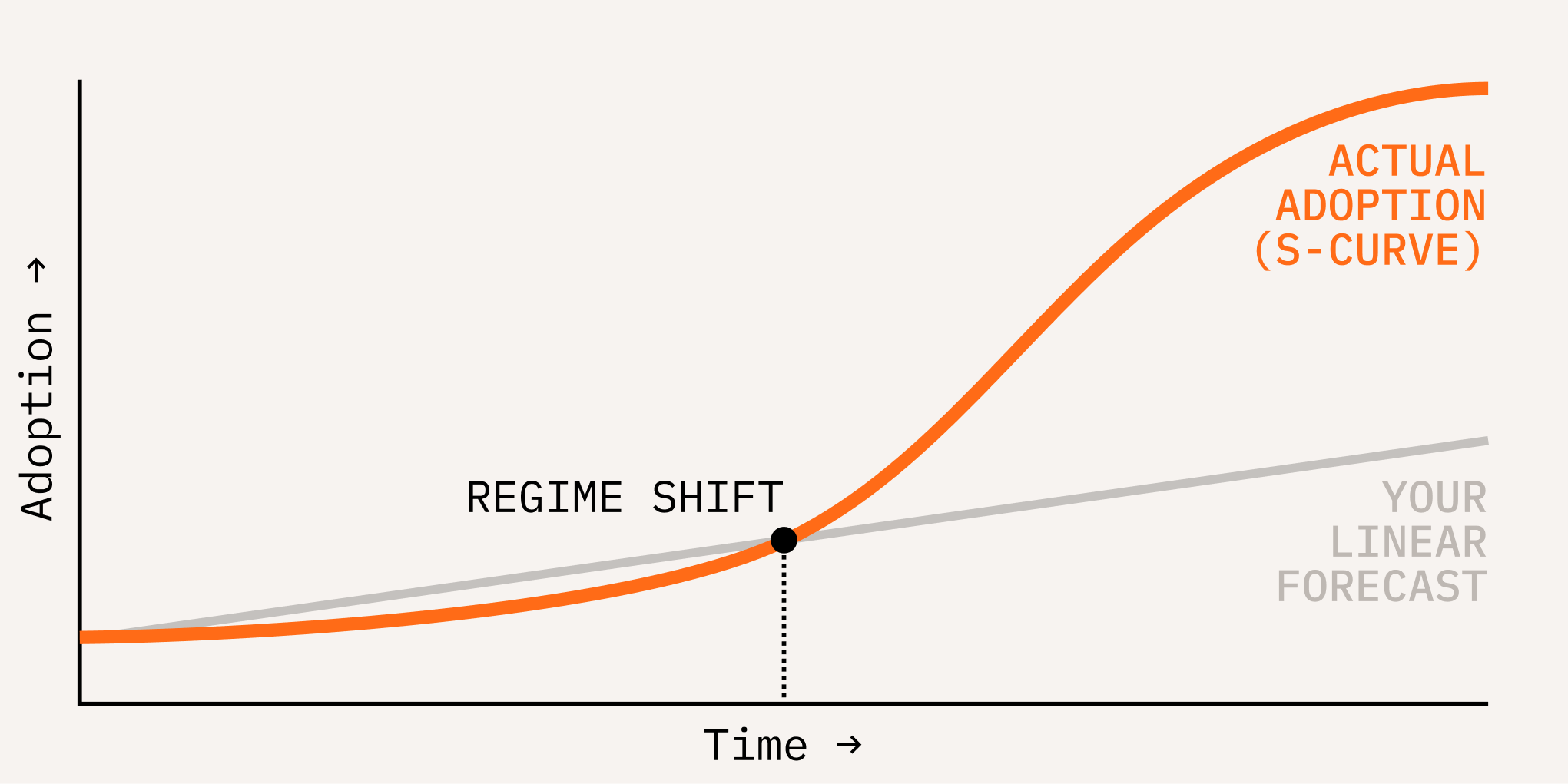
If your model
of the future is linear,
your strategy
is already dead.
An online, international 3-week course built by RethinkX and the Kyiv
School of Economics. Learn to model disruption as a system — structure,
timing, consequences — and read a sector’s flip before the market prices it in.
Apply for the course →
Registration deadline: 14.08.26 ·
6 modules · 1 hour per day · 100% online
Why listen to RethinkX
They called the curve
when the consensus
called a straight line.
Don’t take the model on credentials. Check the forecasts against
what the mainstream institutions said — and what actually happened.
Solar PhotovoltaicSolar PV
In 2014, when solar electricity cost 15¢ a kilowatt-hour, RethinkX said it
would be 3–5¢ by 2020. The IEA said 7¢, and not before 2030. By 2020 it was 3.1–4.2¢ —
RethinkX was right, and the IEA was ten years late.
Electric vehicles
In 2014 RethinkX named the price of a 2023 200-mile electric car: $15,616.
Bloomberg wouldn’t even name a year for EVs simply matching petrol cars until 2026. The
cheapest EV of 2023 came in at $15,741 (in 2014 dollars) — a nine-year forecast that
missed by $125.
Food
& protein
In 2019 RethinkX said new proteins would be 5× cheaper than animal protein
by 2030 and take US dairy and beef down with them. The industry expected a small niche.
So far the price has fallen 70% in three years — not cheap enough yet. This one is still
running.
None of this was a guess. Each call came out of
the same framework — the one you spend six modules learning to run yourself.
RethinkX is an independent think tank that studies
how fast technology replaces whole sectors — and puts a date on it. Instead of asking how
much better a technology will get, it asks what cost level makes the old system stop making
sense, and when that level arrives. That question is what produced the calls above, and it
is what the six modules teach you to ask about your own sector.
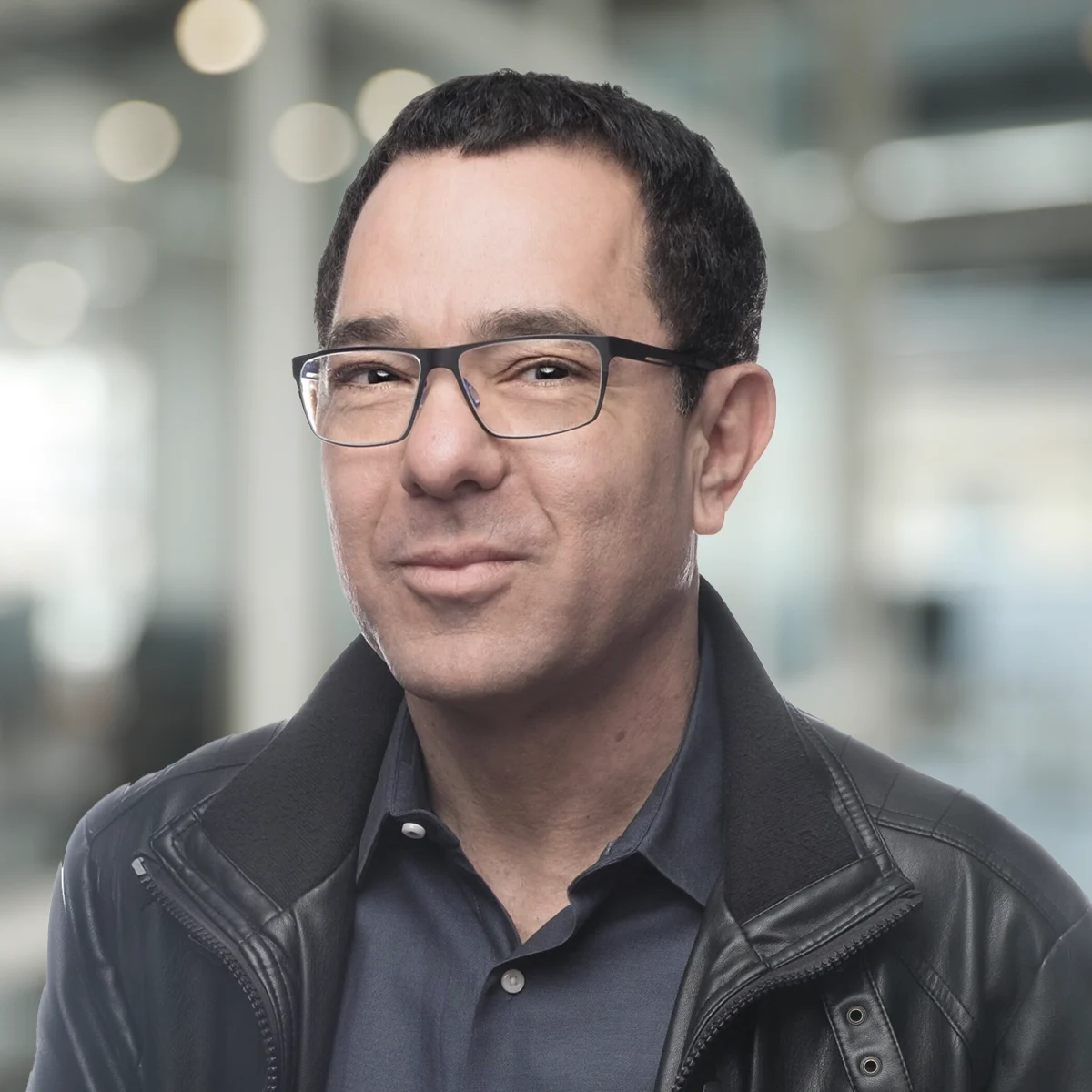
Tony Seba
Co-founder
Called the solar, battery and EV cost curves a decade before the market, at
a time when the energy establishment was still calling them niche. Built the framework
this course teaches, and has spent fifteen years testing it in public against the
institutional forecasts.
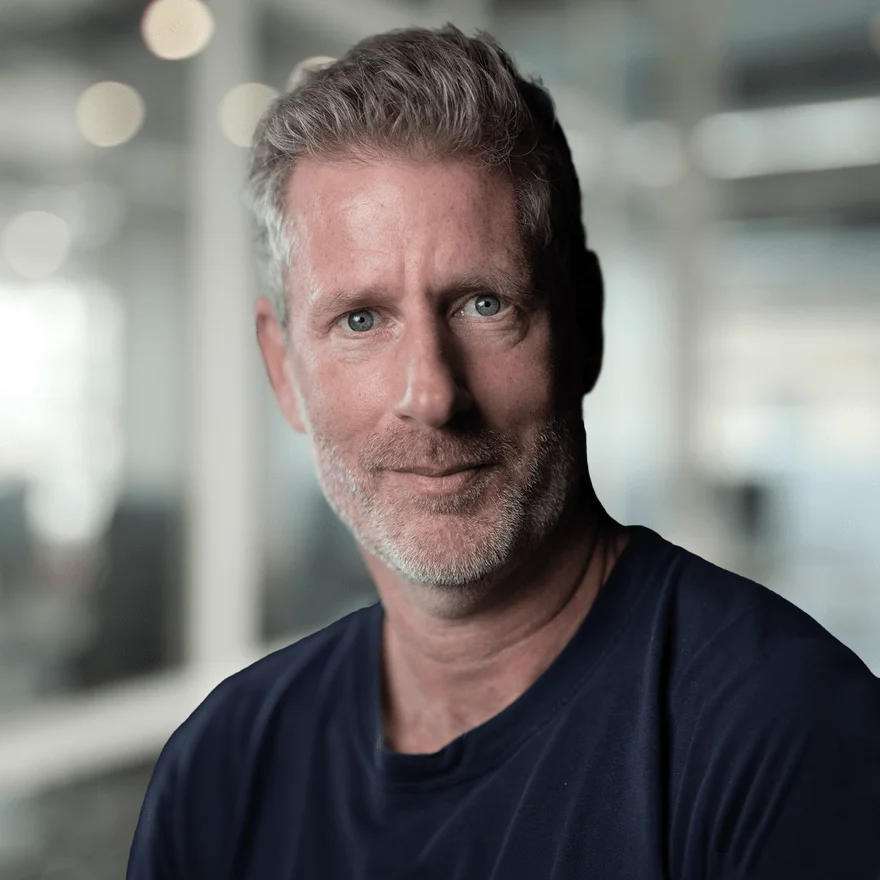
James Arbib
Co-founder
Analysed utilities from the inside as an investment analyst, then co-wrote
the forecast for their collapse. Co-author of Rethinking Transportation and Rethinking
Humanity.

Bradd Libby
Research fellow
Runs the numbers behind the models — energy, materials, cost curves — and
stress-tests them against the critics. The reason the forecasts survive scrutiny is that
someone inside the room is paid to attack them first.
Why Kyiv
Ukraine replaces legacy
systems faster than most
countries upgrade them.
When patching stops being an option, you replace the system instead
of defending it. Kyiv is where that already happened - across sectors at once.
Energy
Power moved off a single centralized grid toward distributed generation;
the centralized model stopped being the default. Ukraine has added over 3 gigawatts of
new renewable energy capacity.
Digital state
Diia made digital ID and passports legally equal to paper first in the
world and put 140+ state services in one app. Paper still exists; it stopped being the
default.
Deftech
Hardware iteration compressed from years to weeks; a domestic industry
built from near zero. Ukraine’s FPV drone production skyrocketed from a few thousands in
2022 to more than two million units in 2024.
This is the course thesis running live: incumbents patch, Kyiv replaced.
You learn these flips from the people who ran the rebuild, not from a
case study.
Kyiv School of Economics — Ukraine’s leading
university, and the think tank. KSE is the reason this course exists in the form it does: it
brought the RethinkX framework to Kyiv and built the programme around a country that is
running the disruption live, so the theory is taught next to the evidence rather than at a
safe distance from it.

Tymofiy Mylovanov
President
Works in mechanism and institutional design — how to redesign systems
rather than patch them. Minister of Economy and Agriculture, 2019–20. Shaped what this
course argues about policy under disruption — the part most frameworks leave out.

Tymofii Brik
Rector
Grew KSE from a small economics school into the university it is now,
through the years the country was rebuilding. Studies trust and social change; runs
Ukraine’s European Social Survey. His research measured what decentralisation did to
trust in communities.
What you’ll actually do
Six modules.
Each one breaks a belief
you currently hold.
-
01. The Pattern of Disruption
The belief it breaks: “Change is linear and predictable.”
-
02. Stellar Energy (SWB Superpower)
The belief it breaks: “Energy will always be scarce.”
-
03. AI & Artificial Labor
The belief it breaks: “Robots just replace workers.”
-
04. Transport, Food, Geopolitics & Environment
The belief it breaks: “Energy will always be scarce.”
-
05. Cognitive Barriers & the Kyiv Mindset
The belief it breaks: “Experts will adapt in time.”
-
06. Stellar Humans & Economics
The belief it breaks: “Growth requires extraction; scarcity is permanent.”
Capstone
In teams, design a “Stellar Nursery” plan for a real city, assuming energy
costs fall ~90%. You leave with an artifact you built — not a
certificate.
Who it’s for
For people who build
ahead of the curve —
anywhere in the world
What every member shares isn’t a title or a budget — it’s agency.
You act on your read of where a sector is going, and a wrong model is expensive. The
cohort is international and deliberately mixed — students, founders, investors, and
policymakers doing the same work, side by side.
Students & early builders
Already building a company, product, or bet — and want a model that holds.
Founders & operators
Betting a company on which way a sector flips, and when.
Investors
Pricing disruption before the consensus does.
Policymakers & regulators
Writing rules for systems about to change shape.
Same modules, same capstone, one mixed cohort. The range of sectors
and vantage points in the room is part of the work.
Not for:
- People who want to listen, not change.
- People who want reassurance, not a real read on their sector.
- People who collect certificates instead of building things.
Your model
of the future is linear.
The future isn’t.
Change that before it changes your strategy for you.
Apply for the course →
Registration deadline: 14.08.26 ·
6 modules · 1 hour per day · 100% online